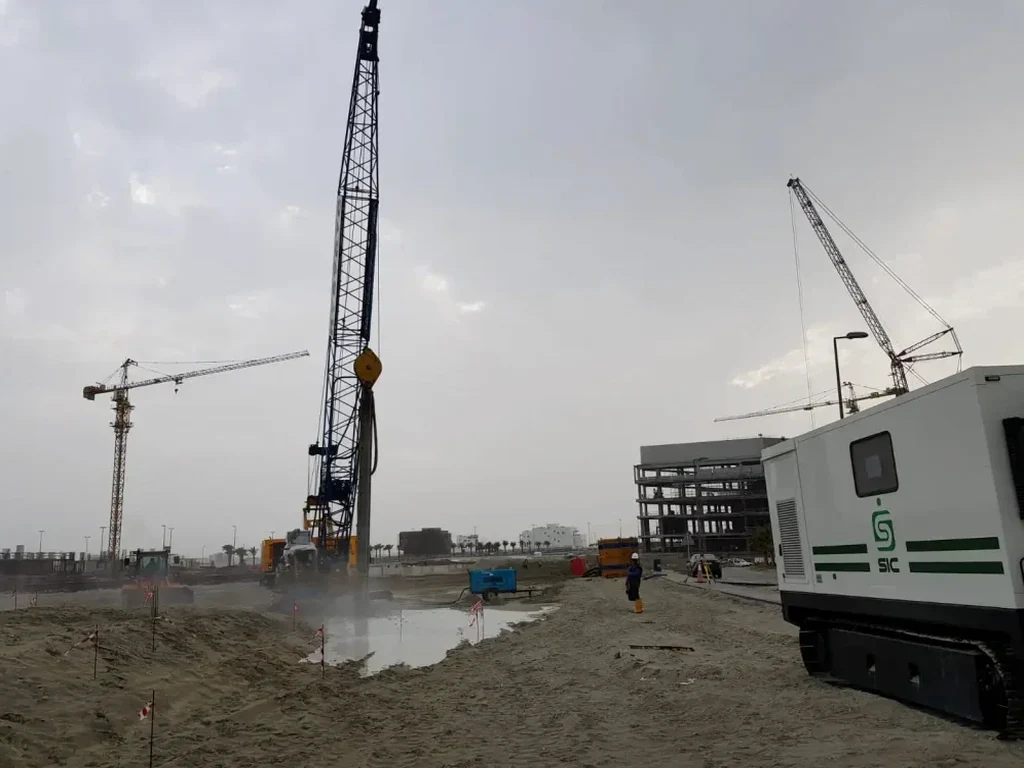
A warehouse extension on the west bank of the Shannon in Athlone hit refusal at 2.2 metres: loose alluvial sand with lenses of silt, incapable of supporting a 40 kPa floor load without differential settlement. That project triggered our first full-scale vibrocompaction design for the Midlands. The native soils here—glaciofluvial sands and gravels overlying Carboniferous limestone—often show relative density below 35% in the upper 4 metres. Standard ground beams and over-excavation push costs past €140/m². Deep vibrocompaction with electric vibrators and water flushing achieves 70% relative density in two passes, verified by post-treatment CPT testing correlated with grain size analysis from our ISO 17025 laboratory. We design the grid, probe depth, and energy input specifically for Athlone's river terrace stratigraphy.
Relative density jumps from 35% to 72% in two passes when the sand fines content stays below 15%—we verify every grid with CPT before and after.
Service characteristics in Athlone
Risks and considerations in Athlone
The Shannon floodplain deposits beneath Athlone contain discontinuous silt lenses that act as perched aquifers. If the design ignores these low-permeability layers, the vibrator saturates them during flushing and the sand above won't compact—it just liquefies and stays loose. Post-construction settlement then appears within the first wet winter, cracking slab-on-grade floors and racking steel frames. We've also measured pH as low as 5.2 in the fill at the former industrial plots along the Dublin Road: acidic groundwater corrodes standard steel casing in under five years. Our design protocol for brownfield sites includes groundwater chemistry sampling and a corrosion protection spec—either sacrificial anodes or stainless steel components—referenced to IS EN 206 durability exposure classes.
Our services
We deliver vibrocompaction design as a complete package—from pre-treatment ground investigation through post-treatment verification—for sites across Athlone and the wider Midlands. Every design is calibrated to the local stratigraphy and groundwater regime.
Vibrocompaction Design Package
Full design including CPT grid, grain size distribution curves, relative density targets per layer, vibrator selection, spacing and energy input specification, settlement analysis using Schmertmann or Burland & Burbridge methods, and construction monitoring protocol. Delivered as a signed design report with CAD layout.
Post-Treatment Verification Testing
QC programme with pre- and post-compaction CPT soundings at every grid intersection, plus shear wave velocity profiling with MASW on larger sites. We compare the before-and-after qc profiles and issue a compliance certificate referencing the design density thresholds.
Frequently asked questions
Is vibrocompaction suitable for the glacial sands found around Athlone?
Yes, in most cases. The glaciofluvial sands and gravels deposited by the Shannon system typically have less than 12% fines, which meets the main criterion for effective vibrocompaction. We verify this with pre-treatment grain size curves from every borehole. If silt content exceeds 15% in a particular lens, we switch to a stone column design for that zone.
How long does the design process take, from investigation to final report?
Field investigation—CPT and sampling—takes 2 to 3 days for a typical 0.5-hectare site in Athlone. Laboratory testing of grain size and moisture content runs 5 working days. The design report with settlement analysis and construction specifications is delivered within 10 working days of completing the fieldwork.
What does vibrocompaction design cost for a site in Athlone?
Design fees range from €1,180 for a small site with 4 CPT soundings to €4,900 for a full industrial plot requiring 10+ soundings, laboratory testing, and a detailed settlement analysis report. The fee covers the entire design package including the construction monitoring protocol and post-treatment verification programme.
Do you handle the treatment itself, or just the design?
We provide the design and the quality control testing before and after treatment. The vibrocompaction execution is carried out by specialist ground improvement contractors. We can recommend experienced operators working in the Midlands and remain available during construction to review the daily logs and confirm that the design energy targets are being met.