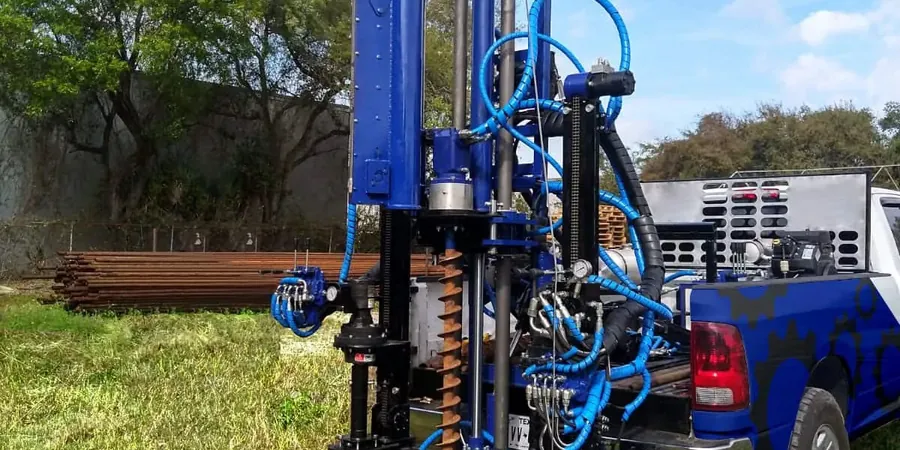
The first thing you'll notice when drilling near the Shannon in Athlone is how quickly the ground changes. Glacial till gives way to soft alluvial silts within a few metres, and that transition can wreck a foundation schedule if you assume uniform bearing. We run SPT in Athlone to pin down exactly where those layers shift, because the N-value doesn't lie — it tells you when you've hit competent material or when you're still sitting on compressible clay that will settle under load. Our rigs have worked both sides of the river, from the IDA business park to the Marina, and the lesson is always the same: a CPT test gives you a nice continuous profile when you need it, but nothing replaces the split-spoon sample for visual correlation with lab classification. In Athlone's mixed glacial-fluvial deposits, combining the two methods saves a lot of head-scratching later.
An N-value without context is just a number. In Athlone's glacial sequence, we interpret it against grain size, water table, and overburden pressure — exactly what BS EN ISO 22476-3 demands.
Service characteristics in Athlone
Risks and considerations in Athlone
We've seen contractors in Westmeath quote a borehole log from 200 metres away and assume the ground is the same. It rarely is. Glacial deposition in the Shannon basin is chaotic — a three-metre lens of soft peat or lacustrine clay can sit between two gravel layers and go completely undetected if your SPT spacing is too wide. Miss it, and your pad footing differential settlement becomes a real headache. The other classic mistake is ignoring the water table correction. In Athlone, groundwater is often within two metres of the surface, especially between October and March. A raw N-value in saturated fine sand below the water table overestimates density; without the Terzaghi & Peck (1948) correction, you risk designing for a bearing capacity that simply isn't there. When the corrected data flags liquefaction potential — particularly in the loose alluvial sands mapped along the old river channels — the liquefaction assessment becomes a non-negotiable step before finalising the foundation system.
Our services
Our Athlone SPT programme is usually part of a wider ground investigation, and we keep the reporting practical — corrected N60 profiles, soil descriptions to BS 5930, and clear recommendations tied to your foundation type. Everything runs through our INAB-accredited laboratory for complementary index testing.
SPT Borehole Logging & N60 Reporting
Full SPT execution with automatic trip hammer, field logging by an engineering geologist, and corrected N60 values. Each log includes stratum description to BS 5930, groundwater observations, and sampling intervals for lab correlation.
Combined SPT & Laboratory Testing Package
SPT sampling paired with particle size distribution, Atterberg limits, and moisture content. Useful when the borehole encounters cohesive layers — the lab data validates the SPT refusal criteria and feeds directly into bearing capacity calculations under Eurocode 7.
Frequently asked questions
What does an SPT in Athlone cost, and what drives the price?
For a standard investigation in the Athlone area, SPT boreholes typically run between €480 and €730 per unit, depending on depth, access conditions, and whether laboratory testing is included. Mobilisation to the Midlands, the number of boreholes, and any traffic management on urban sites influence the final figure. We provide a fixed-price quote after reviewing the site plan.
How deep do you typically go for an SPT borehole in the Shannon basin?
Most projects in Athlone need 10 to 15 metres, but it depends entirely on the structure. A two-storey house on till might only require 6 metres, while a warehouse with heavy racking on the floodplain could go past 20 metres to reach competent gravel. We stop when three consecutive SPT blows exceed 50, which usually means refusal on limestone bedrock or a dense boulder layer.
Is SPT alone enough for foundation design, or do I need CPT as well?
SPT gives you a sample and a number; CPT gives you a continuous resistance profile. In Athlone's layered glacial soils, we often recommend running a few CPT soundings alongside the SPT boreholes. The SPT provides the physical sample for visual classification and lab testing, while the CPT fills in the gaps between boreholes to catch thin soft layers that the split-spoon might miss. Together they're much stronger than either method alone.