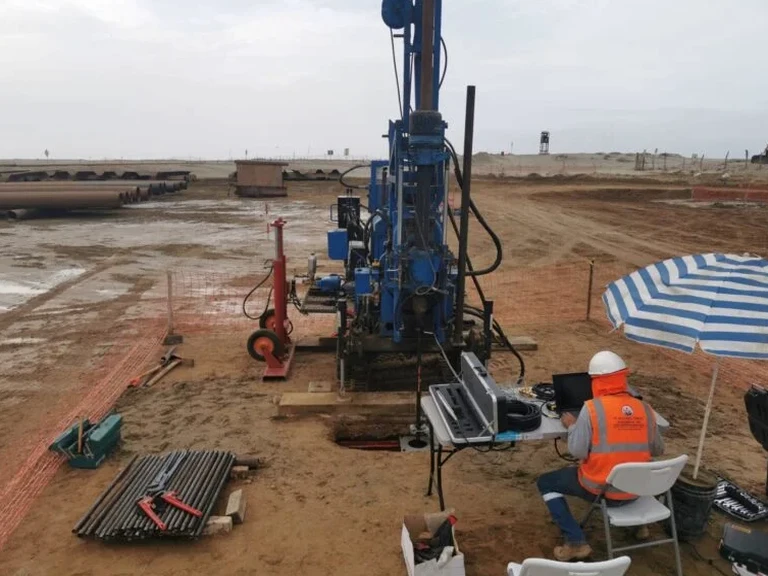
The alluvial floodplains flanking the River Shannon shape Athlone’s subsurface in ways that standard boreholes often miss. Soft lacustrine clays, buried peat lenses, and variable sand layers—remnants of post-glacial deposition—create a stratigraphy that demands continuous profiling. A CPT test captures exactly that: a real-time, uninterrupted log of cone resistance, sleeve friction, and pore pressure, allowing geotechnical engineers to pinpoint thin compressible horizons that discrete sampling can overlook. With the town’s expansion onto former water-meadow land east of the N6 and the industrial estates near Garrycastle, the need for high-resolution ground data has grown sharply. Our team deploys 20-tonne penetrometer rigs capable of reaching depths beyond 25 m in Athlone’s typical drift geology, feeding data directly into Eurocode 7 design models for shallow and deep foundations.
A single CPT sounding replaces half a dozen boreholes when the question is soil continuity—and in Athlone's layered glacial deposits, continuity is the variable that controls foundation performance.
Service characteristics in Athlone
Risks and considerations in Athlone
The contrast between Athlone’s eastern and western banks is stark: the Coosan peninsula rests largely on well-draining limestone till, while the town centre and western approaches sit atop the Shannon’s floodplain sediments, where soft silty clays extend to 8 m or more. A foundation design calibrated for one side of the river will fail on the other. Without cone penetration data, the clay’s sensitivity—often between 4 and 8 in the Athlone area—remains unknown, and sensitive clays can lose up to 80 % of their undisturbed strength when remolded during excavation. Liquefaction assessment adds a further dimension: the sand layers interbedded with Athlone’s lake clays are loose enough to mobilize excess pore pressure under seismic loading, and CPT-based triggering analysis following the Boulanger & Idriss (2014) procedure is the preferred method under Irish Annex NA to Eurocode 8. A single CPT sounding provides both the stratigraphic detail and the cyclic resistance ratio needed to rule out—or design for—liquefaction.
Our services
Our Athlone CPT programme is structured to deliver on three levels: field execution, data interpretation, and geotechnical design integration. Every project receives a calibrated cone log, a soil behaviour type profile, and a parameter derivation report mapped to the design framework being used by the project engineer.
Standard CPTu Sounding
Continuous penetration with qc, fs, and u2 measurement at 20 mm intervals, presented as depth plots with soil behaviour type classification per Robertson (2010). Includes dissipation tests at specified horizons to assess in-situ permeability.
Seismic CPT (SCPTu)
Adds downhole shear-wave velocity measurement at 1 m intervals using a triaxial geophone array. Provides Vs30 site classification per Eurocode 8 and small-strain stiffness profiles for settlement analysis.
Interpretative Geotechnical Report
Derives effective friction angle, undrained shear strength, constrained modulus, and overconsolidation ratio from CPT data using Athlone-specific correlations. Includes bearing capacity, settlement, and liquefaction assessment where applicable.
Frequently asked questions
What depth can a CPT rig reach in Athlone's soil conditions?
In the glacial till and alluvial deposits typical of Athlone, our 20-tonne penetrometer typically reaches 25 m to 30 m before encountering refusal on dense gravel or bedrock. The softer clays of the Shannon floodplain often permit the full 30 m stroke without pre-drilling, while sites on the Coosan side may require pre-augering through boulder-rich till.
How much does a CPT test cost in Athlone?
A single CPT sounding in Athlone typically ranges from €130 to €240, depending on depth, rig access, and whether pore-pressure dissipation or seismic modules are included. A full-day programme with multiple soundings and an interpretative report is quoted on a project basis after site review.
Is CPT accepted for foundation design under Irish building regulations?
Yes. CPT data is fully accepted under Technical Guidance Document A of the Irish Building Regulations when processed in accordance with IS EN ISO 22476-1:2012 and interpreted within the Eurocode 7 framework. Many Athlone consulting engineers specify CPT as the primary ground investigation method for shallow and piled foundations.
Can CPT detect peat and soft organic layers?
CPT is exceptionally sensitive to organic soils: peat produces very low cone resistance (often below 0.5 MPa) combined with high friction ratios and elevated pore pressure. The continuous 20 mm log captures thin peat seams that trial pits and boreholes frequently miss—a critical advantage in Athlone's floodplain where buried organic lenses are common.