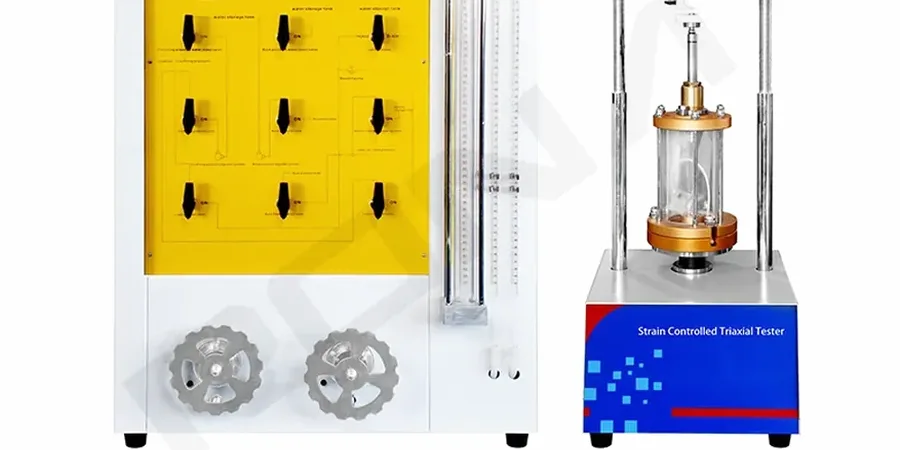
The triaxial cell sits under a loading frame at our geotechnical lab, with a cylindrical soil specimen sealed inside a latex membrane. Confining pressure builds around it through water or air, and the axial piston applies load until failure. For Athlone’s glacial till and alluvial deposits along the River Shannon, we run consolidated-undrained tests with pore pressure measurement. The data feeds directly into bearing capacity models and slope stability analyses. Builders in the Midlands know that guessing shear strength from SPT blow counts alone leads to overdesign—or worse, unexpected settlement. That’s why we pair field investigation with laboratory strength testing. For sites with mixed stratigraphy, we often combine the triaxial test with grain-size analysis to confirm the fines content before selecting the appropriate shear stage.
A single triaxial test replaces a dozen conservative assumptions—and in Athlone’s variable glacial soils, that’s the difference between a lean foundation design and an overbuilt budget.
Service characteristics in Athlone
- Specimen diameter: 38 mm, 50 mm, or 70 mm depending on maximum particle size
- Confining pressure stages: 50 kPa, 100 kPa, 200 kPa for most shallow foundation profiles
- Shear rate: 0.05 mm/min for clays, 0.5 mm/min for silty sands
- Data output: deviator stress vs. axial strain, pore pressure response, Mohr-Coulomb failure envelope
Risks and considerations in Athlone
The Midlands climate brings high seasonal rainfall, and Athlone’s low-lying floodplain means groundwater can rise to within a metre of ground surface from November to March. Soft alluvial silts below the crust lose significant strength when saturated, and a triaxial test run at the wrong consolidation stress misses this risk entirely. We’ve seen effective cohesion values drop below 5 kPa in fully softened Athlone silts—numbers that demand a rethink of shallow footing geometry. Pore pressure response during undrained shear tells us whether the soil contracts or dilates, and that governs whether a foundation fails suddenly or shows warning settlement. For excavations near the Shannon, the triaxial stress path also feeds into retaining-walls design, where wall movement depends on the soil’s stiffness degradation curve measured in the lab.
Our services
Every triaxial testing program we run for Athlone projects includes three distinct service components that ensure the results are usable—not just a lab report with numbers.
Specimen Selection and Handling
We coordinate with the drilling crew to preserve Shelby tube samples from Athlone boreholes, trimming specimens in a humidity-controlled room and verifying initial dimensions to 0.01 mm. Transport from site to lab follows IS EN ISO 22475-1 chain of custody.
Multi-Stage Triaxial Testing
Three specimens from the same depth are consolidated to different effective stresses and sheared to define the Mohr-Coulomb envelope. For Athlone’s stiffer tills, we also run single-stage tests with pore pressure measurement to capture the stress path.
Interpretative Report for Foundation Design
Raw deviator stress and strain data mean little without interpretation. We deliver c’ and φ’ values ready for bearing capacity equations, undrained strength profiles for short-term analysis, and stiffness parameters for settlement prediction under the proposed Athlone structure loads.
Frequently asked questions
How much does a triaxial test program cost for a project in Athlone?
A complete triaxial testing program on three specimens from one depth typically falls between €1,960 and €2,690, depending on the number of confining stages, specimen size, and whether pore pressure measurement is included. Multi-depth programs for larger Athlone developments are quoted per borehole after reviewing the ground investigation logs.
Which type of triaxial test is right for Athlone’s glacial soils?
For the stiff boulder clays common across Westmeath and Roscommon, we recommend consolidated-undrained (CU) tests with pore pressure measurement. This gives both effective stress parameters for long-term drained analysis and undrained shear strength for short-term construction conditions. If the site has soft alluvial silts below the water table, we add unconsolidated-undrained (UU) stages to capture in-situ undrained strength without the risk of sample disturbance during consolidation.
How long does it take to get triaxial test results?
Standard reporting time is 7 to 10 working days after the samples arrive at the lab. Consolidation alone can take 24–48 hours for low-permeability Athlone clays, and shear stages run at 0.05 mm/min to ensure excess pore pressure equalizes. If the project schedule is tight, we can mobilize additional cells and run parallel tests to shorten the overall turnaround.
Do you need undisturbed samples for triaxial testing, or can remolded specimens work?
Undisturbed Shelby tube samples give the most reliable effective stress parameters for Athlone foundation design because they preserve in-situ fabric and stress history. Remolded specimens are used only when the project needs strength parameters for compacted fill, and we recompact to the specified Proctor density and moisture content before testing. For natural ground, always specify thin-wall tube sampling in the site investigation scope.